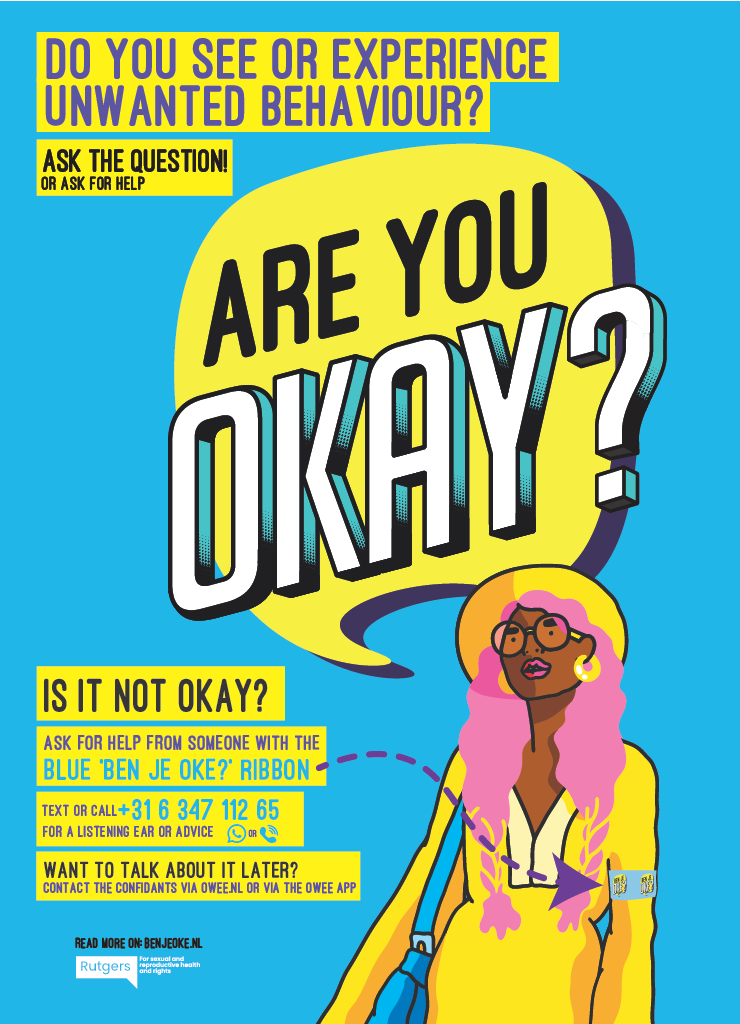
During Welcome Week, we believe it’s important for everyone to feel safe, welcome, and at ease. That’s why we’re running the “Are You Okay?” campaign. The campaign aims to make you and all other (prospective) students aware of inappropriate behavior and shows how you can help if someone doesn’t feel safe or comfortable. Inappropriate behavior is behavior that does not respect a person’s personal boundaries. Examples include offensive comments, unwanted physical contact, or pressuring someone.
The campaign shows that, as a bystander, you can make a difference. By paying close attention and asking, “Are you okay?”, you show that you’re there for someone. Sometimes, a simple question like that is enough to offer someone support or break the ice in an uncomfortable situation. In this way, the campaign encourages you and all other students to look out for one another more often and work together to create a safe environment.
Are you unsure if someone is feeling okay? Then ask, "Are you okay?"
From August 13 through August 21, 24 hours a day, our core team of trained staff will be available to provide support. We believe it’s important to be there to listen to you or offer advice whenever you need it.
They can be reached 24/7 by phone or via WhatsApp at +316 347 112 65.
Are You Okay? – Campaign
-
During activities and at the clubs, you’ll see people wearing a blue captain’s armband featuring the “Are You Okay?” logo. These armband wearers are easily recognizable points of contact you can turn to if you witness or experience something upsetting, such as unwanted (sexual) behavior. You can also turn to them if you feel uncomfortable, are worried about someone else, or have any other request for help. They’ll listen to your story and work with you to figure out how they can help you further.
-
Do you find it hard to approach someone directly? Are you unsure whether a fellow student can answer your question? Or would you rather ask a question anonymously?
From August 13 through August 21, a core team of trained staff will be available 24 hours a day to provide support. We believe it’s important to be there to listen to you or offer advice whenever you need it.
They can be reached 24/7 by phone or via WhatsApp at +316 347 112 65.
-
Together with the armband wearers and the core team, we want to create accessible points of contact that you can turn to if you experience an unwanted or difficult situation. Keep in mind that inappropriate behavior refers to behavior that you or someone else perceives as unwanted, hurtful, or unsafe. The impact of such behavior may differ from the intention behind what was said or done.
-
Here are a few examples of situations in which you can turn to armband wearers or the core team.
- Bullying behavior
o Excluding fellow students
o Speaking negatively about others (online)
o Publicly mocking or ridiculing a fellow student
o Sharing hurtful photos or messages online- Discrimination
o Making jokes about someone’s religion, culture, or nationality
o Excluding someone because of their gender, religion, appearance, or background.- Aggression or intimidation
o Threatening, cursing, or verbally attacking someone
o Pressuring someone to do something against their will. (Peer pressure)
o Abuse of power- (Sexually) inappropriate behavior
o Unwanted physical contact, such as grabbing, hugging, or kissing someone.
o Pressuring someone to engage in sexual acts.
o Sharing intimate photos or information without consent.
o Unwanted sexual comments or jokes
o Abusing a hierarchical relationship.In addition, the core team is also there to listen if you're feeling lonely, homesick, or worried about someone else.
The examples above are meant to give you an idea of situations in which you can ask for support. You don’t have to be certain that something constitutes inappropriate behavior to reach out. If you’re unsure, feel free to contact an armband wearer or the core team. We’ll listen to your story and help you figure things out.
-
Are you contacting the core team? We process personal data; read more about this in our privacy statement. The following applies to the “Are You Okay?” campaign in Delft and the core team: